
Inspect. Mill. Repair the wall.
Three independent examples of robotic cutting and local patch repair: concrete, crossing steel and an intruding rock fragment at a local deformation.
Silent demonstration. Play, pause, or move between the stages. Full description of the demonstration
Reduced motion is enabled. Select individual stages without playback, or read the full description.
Example 1 · Remove concrete and inspect the wall.
The inspection camera records hardened concrete in the drain, then withdraws. A robot with an appropriate cutting burr removes the deposit progressively. This example shows a hole caused at the cutting area, with soil visible through the pipe wall, requiring assessment and repair; damaging sound pipe is not the purpose of milling.
Repair the damaged area and inspect the result.
After withdrawing the robot and preparing the surface, a resin-wetted glass-fibre wrap on an inflatable packer is positioned over the damage. Inflation presses it against the wall. After curing, the packer deflates and leaves; the camera surveys the full patch and both edges.
Example 2 · Steel penetrating two pipe walls.
A steel bar crosses and obstructs the bore. A metal-cutting burr removes the part inside the pipe. Two penetration holes remain on opposite sides of the wall. Clearing the passage has not yet sealed the line.
One circumferential patch covers both holes.
In this local example both holes fall within the repair length. The patch lines the full circumference and covers both penetrations. The camera follows insertion, then returns after packer removal to inspect the clear passage and continuous lining.
Example 3 · External rock pressure and an intruding fragment.
An external rock presses against the wall and a fragment protrudes through the broken area. In this conditional example, an appropriate tool removes the brittle fragment and damaged fold, subject to material and tool suitability. The outer rock remains: milling neither removes the external load nor straightens a collapsed pipe. Stability and damage extent must be assessed; excavation or replacement may be needed instead of milling and patching.
Local repair only after stability and suitability assessment.
This conditional example shows a patch over the prepared local opening. Suitability requires a stable host pipe, appropriate management of the external load and compliance with the repair system instructions. A patch does not automatically resolve rock pressure or pipe collapse. After packer removal, the camera inspects the complete repair and both ends.
Example 1 · Remove concrete and inspect the wall.
The inspection camera records hardened concrete in the drain, then withdraws. A robot with an appropriate cutting burr removes the deposit progressively. This example shows a hole caused at the cutting area, with soil visible through the pipe wall, requiring assessment and repair; damaging sound pipe is not the purpose of milling.
Repair the damaged area and inspect the result.
After withdrawing the robot and preparing the surface, a resin-wetted glass-fibre wrap on an inflatable packer is positioned over the damage. Inflation presses it against the wall. After curing, the packer deflates and leaves; the camera surveys the full patch and both edges.
Example 2 · Steel penetrating two pipe walls.
A steel bar crosses and obstructs the bore. A metal-cutting burr removes the part inside the pipe. Two penetration holes remain on opposite sides of the wall. Clearing the passage has not yet sealed the line.
One circumferential patch covers both holes.
In this local example both holes fall within the repair length. The patch lines the full circumference and covers both penetrations. The camera follows insertion, then returns after packer removal to inspect the clear passage and continuous lining.
Example 3 · External rock pressure and an intruding fragment.
An external rock presses against the wall and a fragment protrudes through the broken area. In this conditional example, an appropriate tool removes the brittle fragment and damaged fold, subject to material and tool suitability. The outer rock remains: milling neither removes the external load nor straightens a collapsed pipe. Stability and damage extent must be assessed; excavation or replacement may be needed instead of milling and patching.
Local repair only after stability and suitability assessment.
This conditional example shows a patch over the prepared local opening. Suitability requires a stable host pipe, appropriate management of the external load and compliance with the repair system instructions. A patch does not automatically resolve rock pressure or pipe collapse. After packer removal, the camera inspects the complete repair and both ends.
Full description of the demonstration
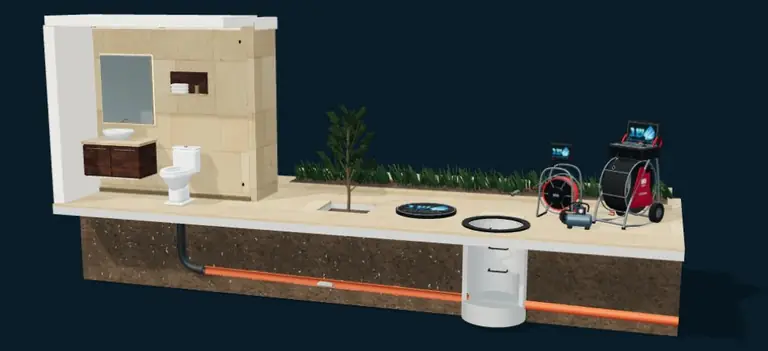
Each example shows the house, garden, ground cutaway, drain and open chamber. An inspection camera enters, records the finding and withdraws. An articulated robot enters and crawls in a repeating sequence: its front bladder inflates and grips, the body contracts to pull the rear forward, the rear bladder inflates, the front releases and the body extends forward. It then works with an appropriate burr and shows the area through its built-in camera. The robot withdraws and the camera returns to inspect the exposed openings. After withdrawing that camera, a packer wrapped in resin-wetted glass fibre enters with a following camera, inflates, waits for curing, deflates and withdraws. The patch stays bonded to the wall. The camera returns and surveys the full repair beyond the far edge. These are independent examples; they change only with equipment outside the line.
Example 1 · Remove concrete and inspect the wall.
The inspection camera records hardened concrete in the drain, then withdraws. A robot with an appropriate cutting burr removes the deposit progressively. This example shows a hole caused at the cutting area, with soil visible through the pipe wall, requiring assessment and repair; damaging sound pipe is not the purpose of milling.
Repair the damaged area and inspect the result.
After withdrawing the robot and preparing the surface, a resin-wetted glass-fibre wrap on an inflatable packer is positioned over the damage. Inflation presses it against the wall. After curing, the packer deflates and leaves; the camera surveys the full patch and both edges.
Example 2 · Steel penetrating two pipe walls.
A steel bar crosses and obstructs the bore. A metal-cutting burr removes the part inside the pipe. Two penetration holes remain on opposite sides of the wall. Clearing the passage has not yet sealed the line.
One circumferential patch covers both holes.
In this local example both holes fall within the repair length. The patch lines the full circumference and covers both penetrations. The camera follows insertion, then returns after packer removal to inspect the clear passage and continuous lining.
Example 3 · External rock pressure and an intruding fragment.
An external rock presses against the wall and a fragment protrudes through the broken area. In this conditional example, an appropriate tool removes the brittle fragment and damaged fold, subject to material and tool suitability. The outer rock remains: milling neither removes the external load nor straightens a collapsed pipe. Stability and damage extent must be assessed; excavation or replacement may be needed instead of milling and patching.
Local repair only after stability and suitability assessment.
This conditional example shows a patch over the prepared local opening. Suitability requires a stable host pipe, appropriate management of the external load and compliance with the repair system instructions. A patch does not automatically resolve rock pressure or pipe collapse. After packer removal, the camera inspects the complete repair and both ends.
A 3D illustration, not footage from a completed job. Actions and resin curing time are condensed. A 110 mm outside-diameter pipe (4-inch class), example 100 mm bore and 50 mm inspection camera. Visual reconstruction of the IMS MICRO S automatic from the supplied equipment photo and manufacturer manual, with a 60 mm module. Housing details are photo-based, not factory CAD. Milling does not straighten a collapsed pipe. Patch suitability depends on structural stability, wall condition, damage extent and the repair system instructions.