
One camera. See what is hidden in the line.
Four independent inspection examples in the same setting — shown from outside and through the camera.
Silent demonstration. Play, pause, or move between the stages. Full description of the demonstration
Reduced motion is enabled. Select individual stages without playback, or read the full description.
Enter through the inspection chamber.
The pushrod runs from the camera reel, through the open hatch and into the drain. The cutaway and the camera monitor show the same scene from two viewpoints.
Example 1 · Roots entering through a joint.
Roots descend from the tree to the pipe joint. Fine roots enter through the opening and branch into a dense internal mat. The camera pauses before the roots to show the restricted passage.
Example 2 · An open joint displaced from the pipe axis.
The pipe ends no longer form a continuous connection: a gap opens and the upstream section is displaced upwards. The view shows the exposed edge, step and bedding beyond the joint. The camera is not forced through the obstruction.
Example 3 · External pressure and an intruding fragment.
In this illustration an external rock presses on the pipe and a fragment enters through the locally deformed, broken wall. The cutaway and internal camera show the same finding. The camera stops before it. Images alone do not establish rock composition or ground stability; assessment is needed before selecting treatment.
Example 4 · Concrete hardened in the pipe invert.
A rough grey mass occupies the bottom of the pipe and reduces the clear passage. The camera pauses to reveal its texture and extent. This is an illustrative scenario; images alone do not verify material composition.
Use the findings to plan the next step.
The camera is withdrawn and the complete line, house and chamber are shown again. Recording the location, nature and extent of each finding supports further assessment and selection of appropriate treatment.
Enter through the inspection chamber.
The pushrod runs from the camera reel, through the open hatch and into the drain. The cutaway and the camera monitor show the same scene from two viewpoints.
Example 1 · Roots entering through a joint.
Roots descend from the tree to the pipe joint. Fine roots enter through the opening and branch into a dense internal mat. The camera pauses before the roots to show the restricted passage.
Example 2 · An open joint displaced from the pipe axis.
The pipe ends no longer form a continuous connection: a gap opens and the upstream section is displaced upwards. The view shows the exposed edge, step and bedding beyond the joint. The camera is not forced through the obstruction.
Example 3 · External pressure and an intruding fragment.
In this illustration an external rock presses on the pipe and a fragment enters through the locally deformed, broken wall. The cutaway and internal camera show the same finding. The camera stops before it. Images alone do not establish rock composition or ground stability; assessment is needed before selecting treatment.
Example 4 · Concrete hardened in the pipe invert.
A rough grey mass occupies the bottom of the pipe and reduces the clear passage. The camera pauses to reveal its texture and extent. This is an illustrative scenario; images alone do not verify material composition.
Use the findings to plan the next step.
The camera is withdrawn and the complete line, house and chamber are shown again. Recording the location, nature and extent of each finding supports further assessment and selection of appropriate treatment.
Full description of the demonstration
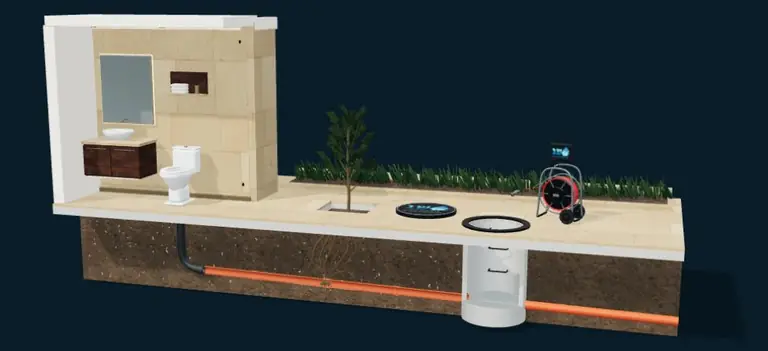
The demonstration shows a house bathroom, garden, ground cutaway and an orange drain connected to an inspection chamber. Only inspection equipment is present. In each example the camera enters through the chamber, advances with its lens and LEDs facing forward, pauses at a finding and withdraws. The monitor shows the bore only when the camera is inside it. The camera is outside during transitions between these independent examples.
Enter through the inspection chamber.
The pushrod runs from the camera reel, through the open hatch and into the drain. The cutaway and the camera monitor show the same scene from two viewpoints.
Example 1 · Roots entering through a joint.
Roots descend from the tree to the pipe joint. Fine roots enter through the opening and branch into a dense internal mat. The camera pauses before the roots to show the restricted passage.
Example 2 · An open joint displaced from the pipe axis.
The pipe ends no longer form a continuous connection: a gap opens and the upstream section is displaced upwards. The view shows the exposed edge, step and bedding beyond the joint. The camera is not forced through the obstruction.
Example 3 · External pressure and an intruding fragment.
In this illustration an external rock presses on the pipe and a fragment enters through the locally deformed, broken wall. The cutaway and internal camera show the same finding. The camera stops before it. Images alone do not establish rock composition or ground stability; assessment is needed before selecting treatment.
Example 4 · Concrete hardened in the pipe invert.
A rough grey mass occupies the bottom of the pipe and reduces the clear passage. The camera pauses to reveal its texture and extent. This is an illustrative scenario; images alone do not verify material composition.
Use the findings to plan the next step.
The camera is withdrawn and the complete line, house and chamber are shown again. Recording the location, nature and extent of each finding supports further assessment and selection of appropriate treatment.
A 3D illustration of four independent scenarios, not footage from a completed job. A 110 mm outside-diameter pipe (4-inch class), an example 100 mm internal bore and a 50 mm camera. The camera stops before the obstruction. Visual findings support diagnosis; treatment selection requires inspection and assessment of site conditions.